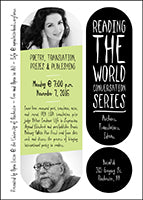
Here’s the full video of our latest “Reading the World Conversation Series” event. This time we talk with with author, translator, editor, and Clarice Lispector expert Benjamin Moser. (Full description of the event is below.)
March 15, 2012 – Over the past few years, Ben Moser’s life has come to revolve around Clarice Lispector. Sure, he’s still a contributing editor to Harper’s, a board member of the National Book Critics Circle, and a frequent contributor to the New York Review of Books, but what he’s most passionate about these days is reintroducing Brazil’s greatest writer to the world. His biography of Lispector—_Why This World_—was the first to be written about her in English, and he’s currently in the process of overseeing the publication of new translations of five of her novels.
During this event we discuss all of those projects, focusing a lot on Ben’s recent translation of The Hour of the Star, which is considered to be one of Lispector’s greatest works.
(This event is supported in part by the National Endowment for the Arts; sponsored by The Dept. of Rare Books, Special Collections & Preservation at the University of Rochester; and presented by Open Letter and University of Rochester Arts & Sciences.)
“Open Letter has made its reputation by finding and publishing some of the best foreign-language writers in the world. Can Xue, the pseudonym of Deng Xiaohua, is the latest writer to contribute to Open Letter’s quick ascension. In her collection Vertical Motion, Can Xue establishes a trippy and surreal world: apartments float high in the air, and large owls and men with lacquer-black skin haunt troubled people.”
Armando Celayo’s full review is available online, over at World Literature Today.
And you can read more about Can Xue’s Vertical Motion right here.
“With his latest, Pilch masterfully negotiates sentiment with a clear-eyed vision of his autobiographical narrator’s shortcomings and disappointments.”
The full review is available over at Publishers Weekly.
And you can read more about Jerzy Pilch’s My First Suicide right here.
“The Cyclist Conspiracy is a defiantly unique and adventurous creation whose roots cannot be so easily traced. The novel is a collection of found texts—memoirs, manifestos, scholarly papers, historical archives, tales, poems, lists, maps, drawings—dedicated to the secret of the Evangelical Bicyclists of the Rose Cross, a mystical sect whose members gather in their dreams and spend their waking lives riding bicycles, smashing clocks, creating havoc, and meditating on the form of the velocipede. . . . Considered by many Serbian critics to be Basara’s best work—and one of the ten best Serbian novels to be written in the past quarter century.”
Taylor Davis-Van Atta’s in-depth article on the work of Svetislav Basara is available at Numéro Cinq.
And you can read more about Svetislav Basara’s The Cyclist Conspiracy right here.
“From her exile in Amsterdam, Ugresic remains one of the funniest, shrewdest, most uplifting writers that Europe can boast. Her new collection of essays, Karaoke Culture, ought to find its way onto the desk of every pundit and politician who rushes to pass judgment on the ex-Yugoslav inferno. With its deadpan humour just this side of heartbreak . . .”
Boyd Tonkin’s full article on “How to quench the book-burners,” about this book and others, is available at The Independent.
And you can read more about Dubravka Ugresic’s Karaoke Culture right here.
Here’s the full video of our “Reading the World Conversation Series” event with author Sergio Chejfec and translator Margaret B. Carson. (Full description of the event is below.)
December 1, 2011 – Sergio Chejfec is the author of a dozen books, three of which are coming out from Open Letter: My Two Worlds (available now), The Planets (june 2012), and The Dark (2013). Spanish author Enrique Vila-Matas singled out My Two Worlds as one of the “best books of the year.” The English edition has been universally praised, with Publishers Weekly saying Margaret B. Carson’s “magnificent translation” should be “treated as a significant event.”
My Two Worlds is a novel about an author walking through a city in the South of Brazil. As he wanders, this unnamed narrator thinks about his walk, about his new book (which isn’t getting very good reviews), and about his life (his birthday is a few days away). At this event, Chejfec and Carson discuss this novel, literature, and the process of translation.
(This event is supported in part by the National Endowment for the Arts and the New York State Council on the Arts; sponsored by The Dept. of Rare Books, Special Collections & Preservation at the University of Rochester; and presented by Open Letter and University of Rochester Arts & Sciences.)
“Death in Spring, like the most challenging narratives do, taught me how to read it. I began reading for imagery, and I found a textured, delicate plot, slung along by the beauty of each line. As I surrendered, I learned to love the book for its strange savagery. . . . When you read this book, read it for its beauty, for the way it will surprise and subvert your desires, and as a testament to the human spirit in the face of brutality and willful inhumanity.”
Full audio and text of Jesmyn Ward’s review, as part of All Things Considered’s “You Must Read This” series, can be found here..
And you can learn more about Mercè Rodoreda’s Death in Spring on our site, right here.
“Chejfec pulls off a sense of metaphysical confusion that, turns out, is a master plan of the literary process—a collision of the two worlds of thought and writing. My Two Worlds is a strange, unique little book that is overwhelmingly a delight to read.”
Daniel Reid’s full review isn’t available online, but you can read more from TLR’s fall/winter 2012 issue at their website.
And you can read more about Sergio Chejfec’s My Two Worlds right here.
“Though one of the pitfalls of existential or absurdist literature is the sacrifice of ‘heart’ and emotion for “ideas” and philosophy, Monzó, in small, masterful strokes, gives his stories a full-bodied existence. . . . In Guadalajara, Quim Monzó joins contemporary short-story writers such as Etgar Keret and George Saunders with the ability to show the absurd in the real, and how the absurd reveals the real.”
Armando Celayo’s full review is available online, over at World Literature Today.
And you can read more about Quim Monzó Guadalajara right here.
“Cerebral and resonant. . . . The interplay between the external surroundings in the park and the man’s inner thoughts is unforced. Silent affinities between him and the park’s denizens—unrealized in actuality, where he barely interacts with them, but vividly imagined in his writerly, hypothetical world—are particularly inspiring.”
Sophie Hughes’s full review is available over at TLS (registration required).
And you can read more about Sergio Chejfec’s My Two Worlds right here.